

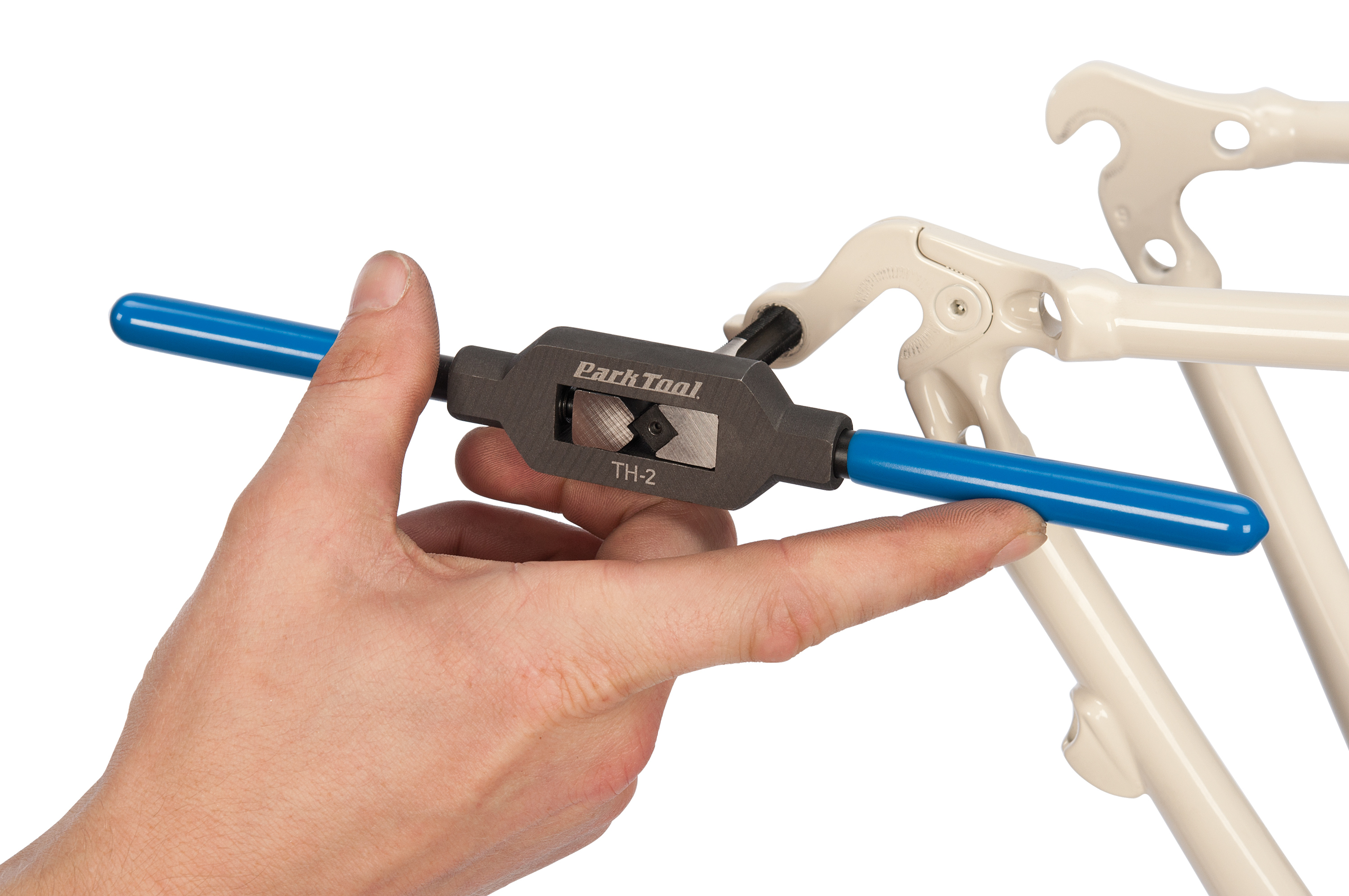
TAPPING A DERAILLEUR HANGER USING A TAP-10 AND TH-2

TAPPING A FORK USING AN FTS-1
Taps and dies can cut threads. Taps cut an internal thread, such as a bottom bracket shell in the frame. Dies cut an external thread, such as a steering column. Thread may also be cut using a lathe, or they may be rolled, such as threads on a spoke end, or on hub axles. For example, a common spoke diameter is 2mm diameter. However, the spoke threading is larger (2.2mm) than the 2.0mm shaft. This is because the crest was displaced upwards when the threads were rolled.
When a thread becomes damaged, there are sometimes options for repair. Typically, when an internal thread becomes damaged, it is damaged at end of the threads, not the middle. If only minor damage has occurred, it may be possible to re-tap the thread. This assumes that enough undamaged thread is remaining to allow proper tightness. As a practical test, after tapping the thread, slightly over-torque from the recommended specification. If the thread is weakened, it will strip and not pass this test. If it does not strip, the thread is adequate, and should survive the use.

Internal threads may sometimes be repaired using a coil system. Recoil® and Helicoil® Companies supply a tap, coil inserts, and coil driver. The damaged thread is drilled out to a specific size. New larger threads are installed with a specifically sized tap. The inserted coil has the outside diameter of the tap, but the coil inside diameter matches the original thread.
Taps and dies are cut to match the desired thread, and also have a helix angle. This is more difficult to see because the threads are not continuous around the tap or die. In a die, the cutting area is referred to as the “lands.” The lands are separated by “flutes,” the gap between the lands. Larger tap sizes are generally made as “skip toothed” taps, with every other thread missing. This helps prevent build up of cut material in the tap.

It is sometimes possible to tap a damaged internal thread to a larger size, and then use the corresponding bolt or screw. This repair may not work if there is little extra material around the damaged threads. If the internal thread is a bottom bracket, the next larger thread is often the “Italian” threading of 36mm. This repair is sometimes possible, but the bottom bracket should have all threads removed before tapping. The original thread inside diameter is approximately 34mm. The bottom bracket shell inside diameter should be 35mm to correctly cut threads of 36mm. Generally, tapping a bottom bracket to the larger 36mm x 24TPI standard is a very difficult slow process. It is also very hard on the taps.
Another option for some external thread repair is a thread file. These are available in both SAE (“English”) and metric thread pitches. This tool acts as a “straight die,” and will trim metal from flattened threads. Hold the die parallel to the helix angle and push the file across the damaged threads.
